Wednesday, November 17, 2010

I, Rigoberta Menchu, an Indian Woma in Guatemala

Our next book is a memoir orally communicated by a Nobel Peace Prize winner, Rigoberta Menchu who wrote the book "I, Rigoberta Menchu; An Indian Woman in Guatemala" (translated and edited by Elisabeth Burgos-Debray). We'll be meeting in the Van Ness neighborhood at It's a Grind Coffee House. 

Here's a book summary:
This book recounts the remarkable life of Rigoberta Menchu, a young Guatemalan peasant woman. Her story reflects the experiences common to many Indian communities in Latin America today. Rigoberta suffered gross injustice and hardship in her early life: her brother, father and mother were murdered by the Guatemalan military. She learned Spanish and turned to catechist work as an expression of political revolt as well as religious commitment. 

The anthropologist Elisabeth Burgos-Debray, herself a Latin American woman, conducted a series of interviews with Rigoberta Menchu. The result is a book unique in contemporary literature which records the detail of everyday Indian life. Rigoberta's gift for striking expression vividly conveys both the religious and superstitious beliefs of her community and her personal response to feminist and socialist ideas. Above all, these pages are illuminated by the enduring courage and passionate sense of justice of an extraordinary woman.

How one woman can start a human rights movement

The book was inspirational and insightful on the beginnings of this incredible organization that helped mainstream the word "Human Rights" - imagine a time when that wasn't even recognized!

It definitely describes the time of Cold War and her challenges to meet regularly with human rights activists. Members of the book club had mixed reviews of her writing style and some had challenges getting into it, but her story was still important to be shared. So many names and different countries - it was hard to keep track of it all, and showcases how great it was for her to remember these people so well and keep in touch in a time when there was no Internet, no email at all. Means of communication are so different now - it makes you see how that can facilitate tracking of human rights violations.

There were definitely inspiring stories that came out such as the activist she met in then Czechoslovakia, who became the first President of that country once it was out of USSR's realm.

It is quite dense but important work to recognize!

Saturday, October 2, 2010

The Courage of Strangers by Jeri Laber

We are now returning to another memoir focused on the founder of Human Rights Watch, Jeri Laber who wrote the book "The Courage of Strangers; Coming of Age with the Human Rights Movement". We'll be meeting in the SOMA neighborhood at Cafe Terzetto this upcoming Sunday October 3 at 2pm.

Here's a book summary:
A homemaker with an academic background in Russians Studies, Jeri Laber gradually became involved with a developing human rights movement in America during the 1970s and 1980s, going on to become the director of Helsinki Watch, an organization that monitored human rights abuses, espcially in the Soviet bloc. Under her guidance, Helsinki Watch broadened its focus to the whole world, eventually merging into one composite organization called Human Rights Watch. 

Laber's book is first and foremost an autobiographical account of her lifelong devotion to exposing human rights abuses and preventing future abuses, interspersed with references to her personal and family life. This account details her often dangerous trips to Brezhnev's Soviet Union and Eastern European nations and chronicles the events leading to the development of Helsinki Watch and Human Rights Watch. 

This book offers inspirational testimony to the value of a human rights organization that investigates and publicizes human rights violations with fairness and without regard to political ideology or U.S. foreign policy.

Next book to read:
Sunday October 31 - I, Rigoberta Menchu, An Indian Women in Guatemala by Rigoberta Menchu (translated and edited by Elisabeth Burgos-Debray)

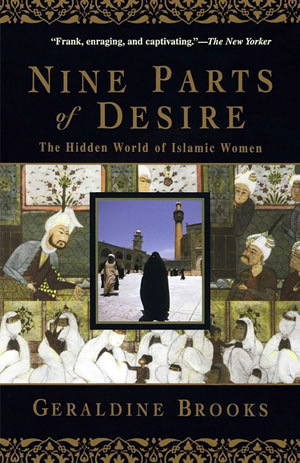
Nine Parts of Desire by Geraldine Brooks

After reading a couple of fiction books, we returned to the non-fiction genre and traveling to the Middle East to read the book "Nine Parts of Desire" by Geraldine Brooks. 

Nine Parts of Desire: The Hidden World of Islamic Women is the story of Brooks’ intrepid journey toward an understanding of the women behind the veils, and of the often contradictory political, religious, and cultural forces that shape their lives. 

Geraldine Brooks spent two years as a Middle East news correspondent, covering the death of Khomeini and the like. She also learned a lot about what it's like for Islamic women today. Brooks' book is exceedingly well-done--she knows her Islamic lore and traces the origins of today's practices back to Mohammed's time. Personable and very readable, Brooks takes us through the women's back door entrance of the Middle East for an unusual and provocative view. 

Through her book, we discussed how still relevant her book was, featuring Islamic women and showing us a more personalized story about women from different countries. That really gave the book a broader perspective and gave us reference to compare women practicing Islam in different countries.

Brooks also described detailed excerpts from the Koran that gives us more to the story of Mohammed, the prophet and the important role women played in his life. It was interesting to see how a Jewish Middle East Correspondent from Australia lived in this period and was able to collect intimate stories of women on the ground.

Sunday, July 25, 2010

Little Bee's journey in the UK

This was an enriching discussion where we felt emotional about Little Bee's life from Nigeria to the circumstances that brought her to the UK. The description of the deportation center is real and the author does a good job in displaying the grim reality of what is happening with immigration in Western countries. 

There is an interesting easy flow to the story as it paths through two voices of women living such different worlds. However, we had issues with the white woman's voice and couldn't grasped the reasons behind her decisions. She was a complex woman based on nothing substantial, in contrast to a young woman from Nigeria who seem to have a simple life until Western greed got in the way.

It was surprising to have a male author write this story and it felt like he over-exaggerated the emotions that women go through to put a dramatic edge.

We felt that there was no big mystery and the one flaw we saw was that the climax came sooner than later and made the ending questionable. Nevertheless, it was a worthwhile read and definitely a book to discuss with friends.

Friday, July 2, 2010

Little Bee by Chris Cleave - July 2010

This month, July,  we'll be discussing the book: Little Bee by Chris Cleave. 

 Location: We're meeting in the Potrero Hill neighborhood - a first for the book club - at Farley's coffee house - www.farleyscoffee.com

Here's what it says on the back cover of the book:
This is the story of two women. Their lives collide one fateful day, and one of them has to make a terrible choice, the kind of choice we hope you never have to face. Two years later, they meet again - the story starts there...
Once you have read it, you'll want to tell your friends all about it. When you do, please don't tell them what happens. The magic is in how the story unfolds.
Sounds intriguing, no? 

August:
Nine Parts of Desire by Geraldine Brooks

Thursday, July 1, 2010

Sisters in the Congo

A story based in the Congo, where war is rampant still today and we read about a missionary family led by a man who feels his calling to impose beliefs on the local people without hesitation. Even though he is the central figure we never really get to hear his voice, because the story is shared by the women in the family.

The four daughters play their own voice, so different from each other and none ever being the ultimate hero. It is all about their experience and their choices, which are unexpected yet reliable.

The writing was such a delight - very easy read yet not lacking in details and I truly appreciate the details of Congo history, Patrice Lumumba, Mobutu as well as Angola's history. It reflects a story of survival, of adaptation, of not letting go of a place that you hate and love at the same time. 

Not sure if this is Barbara Kingsolver's best, although many will argue it is - but encourages to read her other books!