Thursday, February 24, 2011

The power of having an outlet through a radio program!

Xinran's story-telling of her experience as the sole radio host for a women program during the Cultural Revolution in China is fascinating and heartbreaking. 

Xinran splits the book into telling different stories of women who either called in or wrote to her radio program. Each story told was unique and quite heart-wrenching, and brought the reader into that woman's specific story. It's fascinating that Xinran was able to have such a radio program in those times. Xinran channeled the stories of these extreme hardships by the different women living through this period, ranging from surviving an earthquake, following the red guards commands even if it means being separated by the person you love for over 40 years to domestic violence. No cheerful stories here.

Still an incredible read to get a glimpse of what women went through in this specific period.

Wednesday, January 26, 2011

The Good Women of China by Xinran

Thank you for your wonderful discussion on Pride and Prejudice - now it's back to contemporary real issues of women, starting in China.
 
We will be reading The Good Women of China - Hidden Voices by Xinran.

Here's a book summary:
In 1989, Xinran, a Beijing journalist, began broadcasting a nightly program on state radio that was devoted entirely to personal affairs—a radical concept in Communist China. In response, she received thousands of letters from women, many with questions about sexuality; one woman wondered "why her heart beat faster when she accidentally bumped into a man on the bus."

Eventually, Xinran persuaded her superiors to let her share some of these letters on the air, and in this groundbreaking book, written after she moved to London, in 1997, she has also included stories that didn't make it past government censors. This intimate record reads like an act of defiance, and the unvarnished prose allows each story to stand as testimony.

We will be meeting at the Grove Fillmore in Pacific Heights neighborhood! Looking forward to seeing you there.

Next books to read:
March - Mornings in Jenin - Susan Abulhawa

Pride and Prejudice by Jane Austen

Happy Start to 2011!

Also - great time to read comfort books in this season, so before we dive back into our books of realities of women's lives globally - we started festively with Jane Austen! We decided to read her most popular novel Pride and Prejudice.

The carefully controlled and chess-like movements of polite society often conceal passionate hearts, keen minds, and rebellious wills. High-spirited Elizabeth Bennet attempts to stay true to her ideals while her meddlesome mother schemes to get all five Bennet sisters married and to secure their family's fate at all costs. Can a girl who refuses to abandon her independent and scrutinizing ways find true love and a faithful heart? More than one unexpected twist and shocking revelation await our heroine as she must choose between the dashing Mr. Wickham and proud, aloof Mr. Darcy.

How different are we now from the times of 18th century when women wasn't valued until they were married? Do we live a better life now where women have a choice in the matter? Is love overrated? Some of these questions we grappled during our discussion. But we ultimately decided that we loved this book because of the love/hate tension of one of the most romantic couples in literary history.

PS: Some members like the idea of watching the BBC Pride and Prejudice series as a follow up!

Wednesday, November 17, 2010

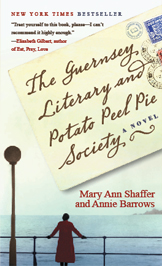
The Guernsey Literary and Potato Peel Pie Society

To celebrate the holidays, I've decided to choose a more light-oriented read that is fictional and has garnered a lot of popularity among women. Our last book for 2010 is The Guernsey Literary and Potato Peel Pie Society by Mary Ann Schaffer and Annie Barrows.
Location TBD - stay tuned!

Here's a summary of the book:
The letters comprising this small charming novel begin in 1946, when single, 30-something author Juliet Ashton (nom de plume Izzy Bickerstaff) writes to her publisher to say she is tired of covering the sunny side of war and its aftermath. When Guernsey farmer Dawsey Adams finds Juliet's name in a used book and invites articulate—and not-so-articulate—neighbors to write Juliet with their stories, the book's epistolary circle widens, putting Juliet back in the path of war stories.

The occasionally contrived letters jump from incident to incident—including the formation of the Guernsey Literary and Potato Peel Pie Society while Guernsey was under German occupation—and person to person in a manner that feels disjointed. But Juliet's quips are so clever, the Guernsey inhabitants so enchanting and the small acts of heroism so vivid and moving. Juliet finds in the letters not just inspiration for her next work, but also for her life—as will readers.

Happy Holidays!

Is it her story or the story of her indigenous community?

The beginning of the story was choppy and dry, focused more on describing details of her indigenous culture. Interesting but not an easy flow to read. However, once she gets into the story-telling of her family and eventually her participation in the struggle, it became much more interesting to read. 

We did find that there were quite a number of contradictions and it was hard to really know whether the story was really her own, as she would describe more about other people than herself. But I still felt the importance of her stories, even though it's not sure whose story they really belong to. The significance of sharing their struggles as a discriminated and marginalized population is high. Figuring out the importance of indigenous identity coupled with Christian faith also emphasized the contradictions in her narrative.

We also questioned the transcriber herself, playing up her role more than it should have been.

In any case, we all agreed that it was worth a read and a great book to discuss about.

I, Rigoberta Menchu, an Indian Woma in Guatemala

Our next book is a memoir orally communicated by a Nobel Peace Prize winner, Rigoberta Menchu who wrote the book "I, Rigoberta Menchu; An Indian Woman in Guatemala" (translated and edited by Elisabeth Burgos-Debray). We'll be meeting in the Van Ness neighborhood at It's a Grind Coffee House. 

Here's a book summary:
This book recounts the remarkable life of Rigoberta Menchu, a young Guatemalan peasant woman. Her story reflects the experiences common to many Indian communities in Latin America today. Rigoberta suffered gross injustice and hardship in her early life: her brother, father and mother were murdered by the Guatemalan military. She learned Spanish and turned to catechist work as an expression of political revolt as well as religious commitment. 

The anthropologist Elisabeth Burgos-Debray, herself a Latin American woman, conducted a series of interviews with Rigoberta Menchu. The result is a book unique in contemporary literature which records the detail of everyday Indian life. Rigoberta's gift for striking expression vividly conveys both the religious and superstitious beliefs of her community and her personal response to feminist and socialist ideas. Above all, these pages are illuminated by the enduring courage and passionate sense of justice of an extraordinary woman.

How one woman can start a human rights movement

The book was inspirational and insightful on the beginnings of this incredible organization that helped mainstream the word "Human Rights" - imagine a time when that wasn't even recognized!

It definitely describes the time of Cold War and her challenges to meet regularly with human rights activists. Members of the book club had mixed reviews of her writing style and some had challenges getting into it, but her story was still important to be shared. So many names and different countries - it was hard to keep track of it all, and showcases how great it was for her to remember these people so well and keep in touch in a time when there was no Internet, no email at all. Means of communication are so different now - it makes you see how that can facilitate tracking of human rights violations.

There were definitely inspiring stories that came out such as the activist she met in then Czechoslovakia, who became the first President of that country once it was out of USSR's realm.

It is quite dense but important work to recognize!